

Economic resiliency in a small town
Blue Earth, Faribault County
Blue Earth is a community of 3,133 surrounded by the farmland of Faribault County. It may be small, but the town has many assets including strong manufacturing and agricultural industries, a downtown that recently underwent a streetscape project and a business district called the Beltline which is host to restaurants and autobody shops. Visitors like to take photos of the Jolly Green Giant statue that stands nearly 56 feet tall near the Welcome Center. However, like many small towns, sustainable economic growth is uncertain when faced with an aging population and fewer financial resources to support entrepreneurs. Fortunately for Blue Earth, a program called Rural Entrepreneurial Venture (REV) is helping to change that narrative.
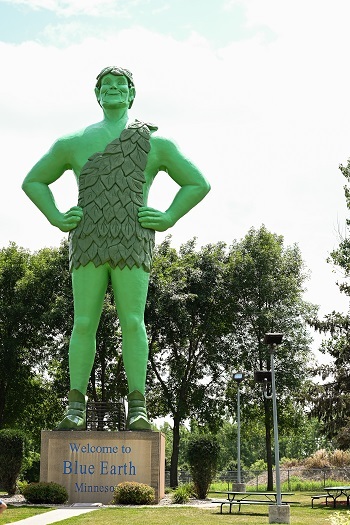
The Jolly Green Giant statue stands nearly 56 feet tall near the Welcome Center in Blue Earth.
When Calli Ferguson was in ninth grade, she did not spend too much time thinking about her future career plans. She had vaguely thought about working in the medical field someday, but most of her energy was put toward school, friends and sports. However, when her teacher told her about a career exploration day for Blue Earth Area High School (BEAHS) students, she decided to attend to see what was out there. She left the event with an entirely new perspective. “I never thought I would be interested in engineering, but the speakers at the event actually changed my mind,” she said. Now in eleventh grade, she says “I’m not sure what I want to do quite yet, but engineering is definitely one of my top choices.”
When Marc Meier, an entrepreneur in Blue Earth, decided to participate in a local Business Succession program, he was not sure what to expect. The information he learned ended up preparing his restaurant for any unforeseen changes so he would not have to close his doors if something were to happen outside of his control. “I want to know my business will survive and be around in the future if something happened to me,” said Meier.
Youth retention and business retention are two critical components to building economic resiliency in small towns, where too often young people leave for jobs in bigger cities, and businesses close when owners retire. Both of these approaches to economic resiliency in Blue Earth are initiatives that were sparked by the REV program.
A “grow your own” approach
The Rural Entrepreneurial Venture program (REV) started in 2018 as a three-year pilot program under Southern Minnesota Initiative Foundation (SMIF), and supported by Blandin Foundation, with the goal of helping small towns develop new approaches for long-term economic growth. The REV model is based on the e2 Entrepreneurial Ecosystems framework from NetWork Kansas\*, which provides guidance to communities for accelerating entrepreneurial activity. The framework, which has been utilized by communities across the country, provides a roadmap for sustainable entrepreneur-focused development.
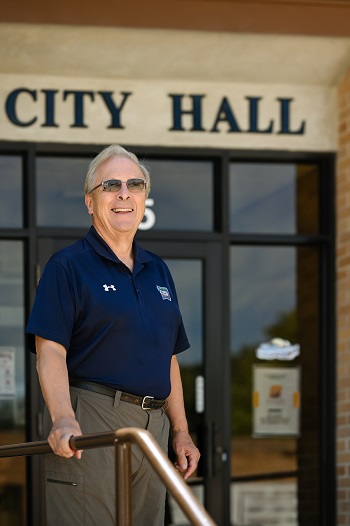
John Huisman, Blue Earth City Councilor, EDA member and president of Blue Earth Community Foundation.
Local City Councilor, John Huisman, heard that SMIF was looking for communities to participate in the REV program and thought it could be a powerful tool for Blue Earth. Huisman, who retired as principal from BEAHS after 25 years, wears many hats in town. In addition to his role on City Council, he serves on the Economic Development Authority (EDA) and is president of the Blue Earth Community Foundation, an Affiliate Fund of SMIF’s, designed to help communities retain philanthropic wealth. He and his son, Quinn, also started the Huisman Family Donor Advised Fund under the community foundation, which provides economic development grants to organizations and loans to businesses in Faribault County and the adjoining areas. His dedication to economic development in Blue Earth is what led him to propose to the City and EDA that they apply to participate in the REV program. “I knew REV was something that could be really good for the community, for everybody,” he said.
Six small towns with populations under 5,000 were chosen after a competitive application process: Blue Earth, Lake City, Lanesboro, Le Sueur, Spring Grove and Spring Valley. The first step for each town was to create a core leadership team. In Blue Earth, a team formed that included Huisman, the County EDA Director, a journalist from the newspaper, City Council members, EDA members, the Chamber Director and several small business owners.
Mary Kennedy, who was contracted as Blue Earth’s EDA specialist through Community and Economic Development Associates (CEDA), became the “community coordinator” for the team. She was excited to see how the REV program could help Blue Earth grow. “Blue Earth is really vibrant,” said Kennedy. “We’re in a really unique position as far as geography and having the right people in the right place at the right time for our community.” The community is located at the intersection of I-90 and Highway 169. “We have a really forward-thinking City Council and EDA board who are willing to make things happen, which is really important for a community when you’re looking to grow or establish new ideas.”
The core leadership teams from each REV community met regularly with coaches from SMIF, Region Nine Development Commission and University of Minnesota Extension who provided them with tools and guidance on how to develop a system to support entrepreneurship and long-term growth. Don Macke, who leads the e2 Entrepreneurial Ecosystems framework, was also an important resource and often provided insights into how communities across the country have created economic change. “Meeting with our coach from SMIF and with Don Macke was always good to get a broader perspective on things,” said Huisman. “You get wrapped up in your community and thinking alike, and sometimes that doesn’t broaden your horizon, so those were good sessions to help us all build our thinking.” SMIF also provides each REV core team an annual stipend of $2,500 to cover expenses for projects, meetings and other duties related to the program.

The Blue Earth REV core leadership team meeting in 2018.
Despite all of this support, the first year proved to be a challenge. “In the beginning, none of us knew what to expect,” said Kennedy. “We really leaned on our SMIF coach for support because we didn’t really know what we were supposed to do or what the outcome was supposed to be. We had a lot of exercises and we were going through the process but didn’t quite understand what we were doing or why we were doing it.” One of the biggest challenges was letting go of immediate gratification. Since REV is built on the principle of systems change, progress tends to be slow and sometimes frustrating. “SMIF told us right away that we’re going to have to really wrap our minds around the idea that we’re not going to see major community results right away. This is going to take five, ten, fifteen years to see big change.”
While they felt somewhat lost in the beginning, after a while they started to see the value in the exercises they were going through. One thing they were asked to do was to mark down all of the things about Blue Earth that they were passionate about, and where they saw opportunities for change. While the ideas were varied, and the prospect of implementing them was overwhelming, it was an important starting point for the team. “When you’re starting out you can have a bunch of ideas with people, but if there isn’t a framework or process that’s being led, you might not be successful,” said Kennedy. “It was definitely very helpful for us for getting started and helps build credibility around the program.” The teams also worked with University of Minnesota Extension on a Ripple Effect Mapping exercise to document the impacts of the program over time.

Mary Kennedy, community coordinator for the Blue Earth REV core leadership team and the Blue Earth City Administrator.
The REV teams were given a variety of tools to work with including a database for conducting an inventory of the existing entrepreneurs in Blue Earth. Many small towns do not have a method of tracking businesses in the community. Additionally, there are many entrepreneurs who work out of their home rather than out of a storefront. The database, called SourceLink, helped them track businesses and any interactions that they had with entrepreneurs, in order to get a better sense of who they needed to support.
The teams were also encouraged to conduct a survey of ten businesses in order build deeper relationships with entrepreneurs and get a sense of how REV could be of assistance. “The answer might not even come out in the survey,” said Kennedy. “It might come out in a conversation after the survey has been done. If a business needs help with marketing, REV is not there to help with marketing, but we’re there to help connect them with someone who does marketing. It’s that connection. It takes some of that work off of one person. It’s building a system for a community to be able to help entrepreneurs. If you’re in a coffee shop talking about something you need, then someone else who is there can tell you where to go for help.”
As they worked through the first year of trying to figure out what REV could look like in their town, it was helpful for them to meet with the other REV teams. “One of the biggest things that has been helpful for us is that SMIF has connected us with all of the other REV communities,” said Kennedy. “That has been really valuable for me and for the other teammates. All of our REV groups are doing very different things, so learning from each other and seeing how other communities have taken this on has been really interesting.”
The teams soon realized that REV is not a one-size-fits all approach to economic growth since each town is unique. After nearly a year of conversations, the Blue Earth team started to see that one of the subjects that kept rising to the top for them was how to support future entrepreneurs.
Supporting the next generation
Late into the first year of the REV program, the Blue Earth core team sent a survey to all students in ninth and tenth grade asking them about their future career aspirations. The majority of the students who responded indicated little to no interest in remaining in or returning to the Blue Earth area after high school, due to their perception that there was a lack of job opportunities. “The Blue Earth Area High School used to have a vocational program that was one of the best in the state, but the funding was cut years ago,” explained Huisman. “Our youth leave, and very few come back.” High schoolers were able to work anywhere in the community and get school credit. With that connection severed, students were less aware of local career opportunities and were less likely to remain in the community. “It turns out we couldn’t talk about entrepreneurs without talking about the next generation of workforce that was the students,” said Kennedy. “We couldn’t get past that conversation.” The REV team knew that in order to cultivate future entrepreneurs, they needed to start with changing students’ perceptions of local opportunities.

Calli Ferguson, a BEAHS student who attended one of the REV career events and became interested in engineering.
The team decided to host an event to introduce high schoolers to local career options. They brought in speakers from a variety of industries including a plumber, an electrician, a construction manager and a manufacturer. When only four students showed up to the event, the team was devastated. “We really thought we did something wrong,” said Kennedy. However, they soon learned that even a small reach can make a big difference. “I was at a manufacturing business a couple of weeks later and the owner, who had spoken at our event, said he hired one of the students who attended,” she said. “There were only four kids there but one of them got a job, and the manufacturer got an employee. That’s when everything changed for us.”
Encouraged by the positive outcome, the REV team organized a second event which included representation from professional service jobs like a veterinarian, a banker and a City engineer. The turnout was slightly better with 15 students and several parents attending, but the REV team had still been hoping for higher attendance. However, after the meeting, they discovered that one of the students had written them a note:
“I just wanted to write a quick note to say thank you for hosting the career explorations night at BEAHS. I learned a lot about what I might want to do in the future. I never expected to be interested in engineering but this made me realize that might be a good fit for me.”
– Calli Ferguson
The REV team went from discouraged to hopeful, and they were even able to set up a job shadowing experience for Ferguson. “That’s exactly what we wanted, even though the events weren’t having a huge turnout,” said Kennedy.

A note to the REV team written by Calli Ferguson after she attended their career event.
From there, a couple of things happened. The school superintendent joined the REV team, which helped them expand on their outreach and get more students involved, including those who live outside of Blue Earth since the district encompasses five communities. Then, in the summer of 2019, they received a $7,500 Small Town Grant from SMIF to support a series of career events which they called SHOP Blue Earth (Support. Host. Offer. Participate.). They started with a “lunch and learn” where they invited businesses into the school to meet with ninth and tenth graders. This was followed up by a tour of 30 different businesses which 150 students attended. “The Small Town Grant allowed us to involve more people and more businesses in the project,” said Kennedy. “Without the grant we wouldn’t have been able to have such a large scope.” They plan to follow up with a third event to bring the businesses back into the school to talk about specific internship and job opportunities.
Word started getting around about the SHOP program and the opportunities that exist within the community. “The sessions opened the eyes not only of the students, but it opened the eyes of their parents so that they’re not necessarily encouraging students to find jobs outside of the community,” said Huisman. After just a short period of time, the program has become an important part of how Blue Earth thinks about economic growth. “Now SHOP has taken on a life of its own alongside REV and has really grown as we have gotten the Small Town Grant and gained more partners who really believe in the program,” said Kennedy. The School District hired a workforce coordinator through CEDA to focus on the SHOP program. REV also recently applied through SMIF to host an AmeriCorps VISTA member who will help build relationships with students who they have had a harder time reaching due to language and financial barriers. “SHOP has become a huge part of what we do and who we are in Blue Earth. It’s a big part of the EDA’s work and part of what the business community hears about and wants to be involved in.”
Keeping businesses alive
The REV program had begun to make strides in youth retention, but the team knew they also needed to focus on the other end of the spectrum: how to keep businesses from closing when owners retire or step back for other reasons. They decided to bring in a specialist from University of Minnesota Extension to lead an information session about business succession. “There was a packed house that night,” said Huisman. “There was a great need. A lot of people came, including farmers, to discuss their business operations. We had no idea if we would have five people or 15 people at that session, but we had 40 people show up.”

Marc Meier, owner of the Cedar Inn, a drive-in restaurant.
One of the business owners who attended the session was Marc Meier. He became an entrepreneur in 2015 when he bought a drive-in restaurant and self-serve car wash called the Cedar Inn. The restaurant had been a popular Blue Earth destination for decades, but the previous owners closed it when they retired in 2012. Meier had been interested in opening a restaurant, and he kept hearing about how people missed the Cedar Inn. “The town needed it,” he said. “The town missed it.” So, encouraged by his wife, he decided to buy it. At the time, REV didn’t exist, so he navigated being an entrepreneur on his own. “I had to figure out who to talk to on my own for business plan support,” said Meier. “It was really difficult.” So, when Kennedy asked him to join the REV team, he saw an opportunity for helping future Blue Earth entrepreneurs. “I said yes because I want to be able to help other people have a better process for opening businesses here.”
As a new business owner, Meier was not thinking about retiring anytime soon, but he wanted to make sure the restaurant could live on if he ever needed to step back from it for any reason. He attended the business succession program and then decided to participate in a follow-up ten-week program. UMN Extension selected Blue Earth to be part of this pilot program because of their work with REV. Meier was matched with a local coach, who happened to be Kennedy, and participated in peer group conversations with other participants from all over southern Minnesota. “I found this to be extremely valuable,” said Meier. “I never thought I would need to start planning to exit as soon as I entered, but there are some things I need to do now to make it easier if an emergency comes.” For Meier that includes documenting all of his recipes and lining up key people to take over for the place to operate without him.

The Cedar Inn, a drive-in restaurant in Blue Earth.
An emergency came sooner than anyone would have expected, as the program began the same month that restaurants and countless other businesses were shut down to slow the spread of COVID-19. “We had a lot of real-life discussions,” said Meier. “There is more urgency to do disaster planning now.” While the pandemic was unexpected for everyone, Meier points to other scenarios that can negatively impact business, like street closings or medical emergencies. “The pandemic assured me that it’s important to come up with plans no matter what. You can’t plan for everything, but you need to innovate.” He sees the programs and systems that REV is setting up for entrepreneurs as a sustainable way for Blue Earth to grow. “REV is keeping our town on the map by supporting small businesses – this generation and into the next generation.”
The future of REV
Now in its third year, REV has become more embedded into the culture of the town. “Before REV, there wasn’t necessarily the same focus on entrepreneurs and business startups as there is now,” said Kennedy. The team even developed a logo and a new name, “BEA REV’d Up,” which has helped cement its importance in the community. “It wasn’t that the City or EDA wasn’t supportive, but now we know how to measure success differently. When I started, we wanted to do loans and help a certain number of businesses, and now we’re a little more open to programming and working with startup businesses and taking on more risk with different financial assistance programs.”

Downtown Blue Earth
While the program through SMIF ends after three years, the Blue Earth community intends to keep REV going. “In Blue Earth, it goes beyond entrepreneur support, which is at its core – that’s the meat and bones of it,” said Kennedy. “If we took REV away from the community, people would wonder why. If we stopped talking about it, the business community would wonder why, the school district would wonder why. It’s become part of the community now that it’s taken on a life of its own.” The City Council Chambers even has the map from the Ripple Effect Mapping exercise up on the wall, a testament to the importance of the program. “REV might mean something different to each person, but the base of it is that we want to provide resources to the people who want to be successful in Blue Earth. It might be a new business, an existing business, a student, or it might even be someone outside of Blue Earth.”
Kennedy, who is now the Blue Earth City Administrator, says that just being able to talk about REV with prospective businesses has been a game changer. “SMIF has provided resources along the way that have been really helpful for our group and our community and has really built credibility around what we’re doing,” she said. “When a business says they are interested in Blue Earth and another community, they ask why they should choose Blue Earth,” she said. “I can say all the normal things, but I can also say we have this thing called REV, and we are really building a community around entrepreneur support and have a community of people who want to help you with no strings attached. People are really interested in that. It’s not just a glamourous thing to say. It’s true. It’s what Blue Earth has become.”
For Blue Earth, the future of economic growth in their small town is clear: REV is here to stay.
Watch Blue Earth REV – SMIF Impact video
*NetWork Kansas is formerly the Center for Rural Entrepreneurship.


